Start from what the shopper already does
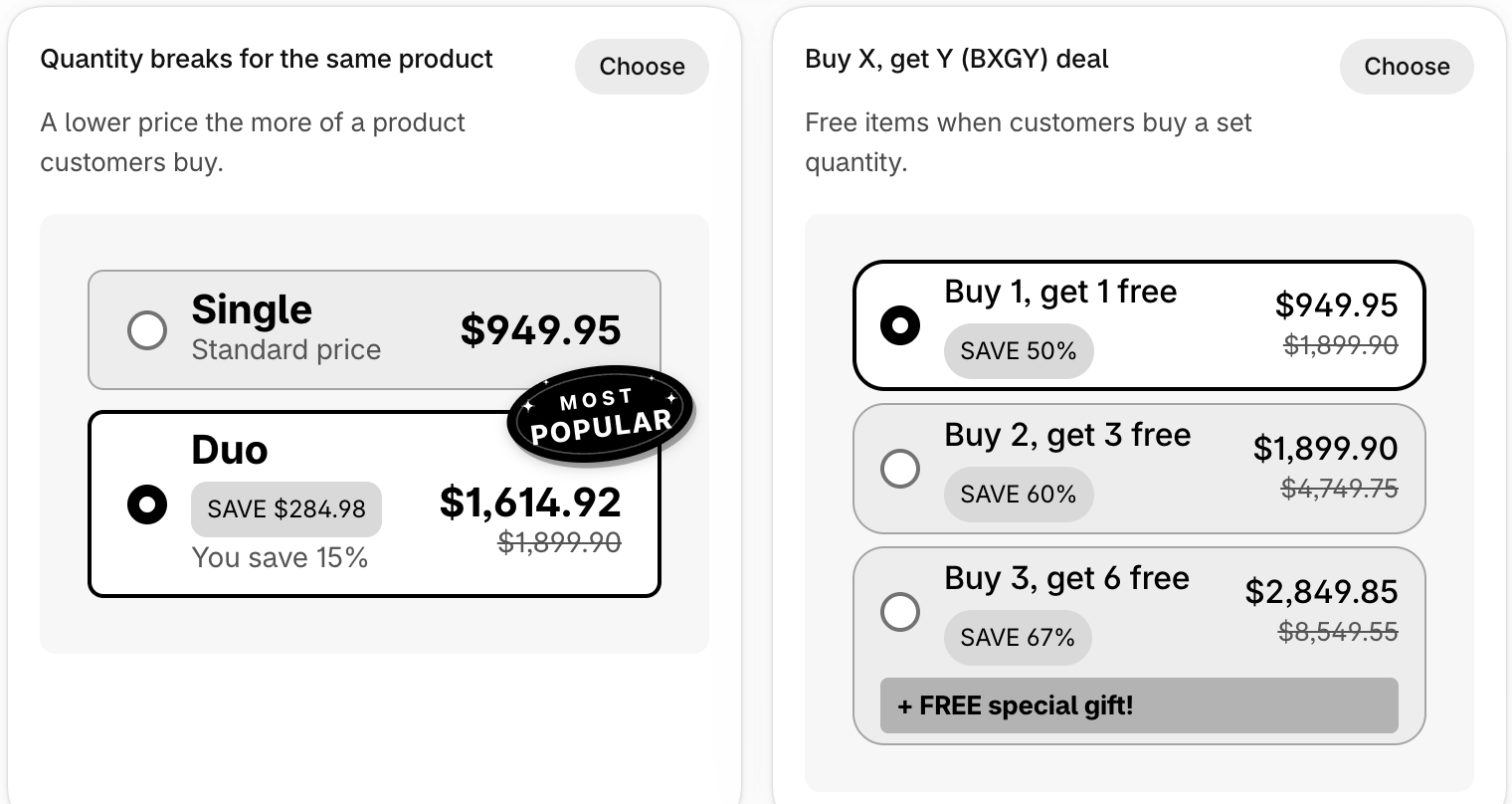
Every volume offer tries to change one decision on the product page: how much goes into the cart. The three common shapes push in different directions. A quantity break asks for more of the same thing. A bundle asks for a second, different thing. A free gift leaves the price alone and gives something away once the order reaches a level you choose.
So the useful question is not which offer converts best. Nobody can answer that for your store, including us. The useful question is what a shopper of this product already does on a good day, and which offer makes that easier rather than asking them to change their mind.
Quantity breaks suit things people run out of
Candles, coffee, socks, skincare refills, dog treats: anything a customer uses up and buys again is a natural quantity break. The shopper was going to come back for a second one anyway, and a lower price for two or three now saves them the trip. The offer reads in one line, buy 2 and save 15 percent, and needs no explanation.
A quantity break suits a product nobody needs two of far less well. A jacket at three for the price of two mostly produces returns or no reaction at all. Where the product comes in colours or scents, let the shopper pick a different variant for each item, because two of the same scent is a harder sell than one of each.
A close cousin is buy one, get one: the same product, with the extra units free or discounted. It says what a quantity break says in a louder voice, and it suits products with a low cost of goods, where the free unit costs you little.
Bundles suit products that are used together
A bundle earns its place when the second product makes the first one better: a grinder with the beans, a cleaning kit with the shoes, a refill pack with the starter bottle. The shopper is already picturing using the product, and the bundle finishes the picture. A bundle of two unrelated best sellers rarely does that. It just asks for more money.
Two rules keep a bundle honest at checkout. The discount needs the whole set in the cart, so a shopper who removes one item pays full price for what remains, which is fair but worth saying on the page. And a bundle is more than one line in the cart, so a one click buy button that skips the cart usually cannot carry it.
Mix and match sits between the two. The shopper fills a set of slots from a list you choose, say any three candles from the winter range for one price. It suits a range of similar products where choosing is part of the fun, and it keeps the set price simple.
Free gifts suit a price you do not want to cut
A gift is the offer to reach for when the product price is part of the brand. Nothing on the page is discounted. The shopper gets a sample, a travel size or free shipping when the order reaches a quantity. Progressive gifts take the idea further, unlocking a second and third reward at higher tiers, which turns the tier list into a ladder rather than a price table.
Do the arithmetic on your cost, not on the gift's shelf price. As an example, a travel size that retails at 12 dollars and costs you 3 dollars is a 3 dollar offer. A 15 percent discount on a 60 dollar product is a 9 dollar offer. Those figures are made up; put your own cost of goods into the same sum.
Watch what happens when the cart shrinks. If a shopper qualifies for a gift and then removes items, the gift has to stop being free. In TreStack Bundles the gift line stays in the cart at its full price rather than being removed, which is worth knowing before a shopper writes in to ask why the total went up.
A short way to decide
If the product is used up and bought again, start with a quantity break. If it needs a companion to be useful, or is much better with one, build a bundle around that companion. If the price is part of what you are selling, offer a gift. If you cannot choose between two, that is what an A/B test is for, and the resources hub has a guide on reading one without fooling yourself.
Whichever you pick, run one offer per product. Two deals on the same product compete for the same cart line, and the checkout result then depends on how Shopify combines discounts rather than on what the shopper saw. TreStack Bundles shows one deal per product in its widget, but every published deal's discount still runs at checkout, so the editor warns you when a product is already in another deal.
TreStack Bundles is on the Shopify App Store. The docs below describe each deal type as the app builds it, including the limits worth knowing before you choose.
In the TreStack Bundles docs
New to the app? What TreStack Bundles does, or install it from the Shopify App Store.
On the same subject
Setting quantity break tiers without giving your margin away. A percentage off the price is a bigger percentage off your margin. Worked arithmetic for quantity break tiers, using clearly labelled example prices.